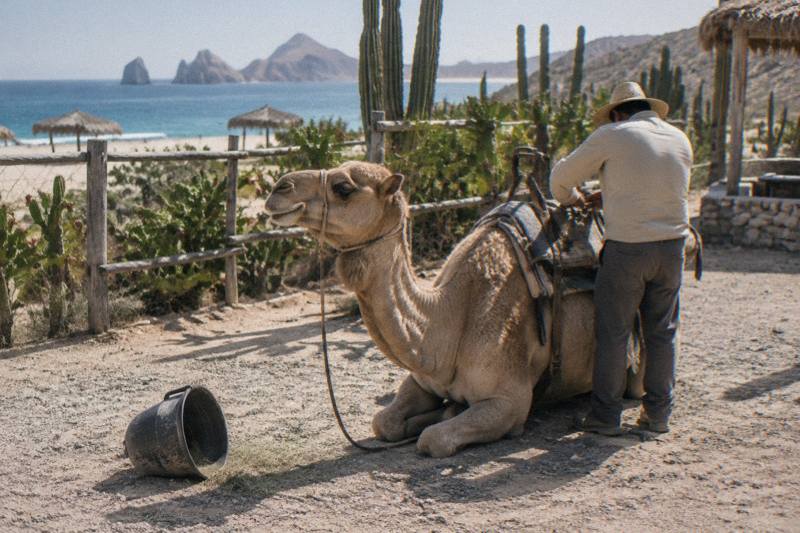
Is Camel Riding In Cabo Ethical? What To Look For In An Operator
The honest answer is that it depends on the operator, and the difference is visible on the listing before you ever book. Here is what the Cabo operators themselves state about camel care, what the rider limits tell you, and how a doubtful reader can choose a ride that treats its animals well.

Short answer
No Cabo operator publishes a full welfare audit, so the honest test is what each one states and limits. Cactus Tours says its camels are part of a specialized rescue and care program under a registered SEMARNAT scheme. Wild Canyon rides in the canyon because beach salt irritates camel skin. Riders weight limits run 100 to 125 kg depending on operator.
Riders walk away from a Cabo camel ride with very different stories, and the difference usually traces back to one thing: which operator they booked. There is no single seal, no independent certification stamped on every listing, and no council that inspects camel welfare across the Tourist Corridor. What exists instead is a paper trail of stated policies, rider limits and operator descriptions, and that trail is surprisingly readable once you know what to look for.
This guide takes the question seriously rather than brushing it aside. It lays out what the main operators actually say about their camels, what the age, weight and group-size limits imply about animal load, and how the rides are paced. It draws only on what operators and listings state, and it flags plainly where a claim comes from one operator's own page rather than an outside check. The goal is that a doubtful reader finishes knowing exactly which questions to ask before paying.
Is Camel Riding In Cabo Ethical On The Whole?
There is no outside welfare certification for Cabo camel rides, so the fair answer is operator by operator. The verifiable signs point in a mixed but readable direction: Cactus Tours states its camels are part of a specialized rescue and care program, Wild Canyon limits each camel to 100 kg and explains why it rides in a canyon, and every major listing caps rider weight well below what a camel can physically carry.
Start with the basic physical question, because it is the one most first-time visitors ask. A riding camel is a large, load-bearing animal, and the rider weights permitted on Cabo listings, 100 kg at Wild Canyon, 120 kg on Cabo Adventures rides and 125 kg on Cactus Tours rides, are conservative relative to the loads pack camels have historically carried. That does not settle the question by itself, but it removes the picture of an animal struggling under an unreasonable burden.
The harder questions are about treatment, rest and living conditions, and those are where the operators' own words matter. Cactus Tours keeps its camels at what it calls a Wildlife Conservation Center, describing it as a registered PIMVS, an Integrated Management Program for Wildlife under Mexico's SEMARNAT environmental authority, and states that its camels are part of a specialized rescue and care program. Its page names Choyerito, described as the first camel born in Los Cabos, as part of that program. Wild Canyon, for its part, explains a concrete husbandry choice: it rides its camels in the canyon rather than on the beach because beach salt irritates a camel's sensitive skin, and it states that its guides may pause or end a ride for the animals' wellbeing.
What no operator publishes is a full independent audit, and honesty requires saying so. A skeptical reader should treat operator statements as exactly that, statements, and weigh them alongside the structural evidence: weight caps, minimum ages, group limits and slow pacing. On that combined record, the established Cabo operators read as operations that have thought about welfare and put limits in writing, which is more than many tourist animal activities can show. For a fuller walk-through of the day itself, see the what to expect on a Cabo camel ride guide.
What Do The Cabo Operators Say About Camel Care?
Each operator's public page says something different, and the differences are the useful signal. Cactus Tours alone claims rescue status, in its own words, for its camels. Wild Canyon explains a husbandry reason for its canyon location and gives guides authority to stop a ride. Cabo Adventures ties its weight limit explicitly to the camels' wellbeing, phrasing that appears in the listing text itself.
The clearest welfare statement in the lineup comes from Cactus Tours. Its page states the camels are part of a specialized rescue and care program and describes the facility as a registered PIMVS under SEMARNAT, the federal environmental authority that regulates managed wildlife in Mexico. You can read the claim in the operator's own words on the Cactus Tours camel ride page. No other operator in the lineup makes a rescue claim for its camels, and this site repeats the claim only for Cactus Tours because only Cactus Tours states it.
Wild Canyon's statement is different and, in a practical sense, just as informative. Its page says camels are ridden in the canyon rather than on the beach because salt irritates their sensitive skin, and that guides may pause or end a ride for the animals' wellbeing. That second clause is worth pausing on: it gives a frontline worker explicit permission to cut revenue-generating activity short for the animal's sake, which is the kind of policy a purely commercial operation does not volunteer. The details are on the Wild Canyon camel ride page.
| Operator | What it states about camel care | Where the claim lives |
|---|---|---|
| Cactus Tours | Camels are part of a specialized rescue and care program at a registered SEMARNAT PIMVS facility | Operator page |
| Wild Canyon | Rides in the canyon because beach salt irritates camel skin; guides may pause or end a ride for the animals' wellbeing | Operator page |
| Cabo Adventures | Rider weight limit of 120 kg stated "for the camels' wellbeing"; cameras not permitted during the ride | Listing text |
| FunCabo, Baja Discover, Gray Line, One Way Mexico, Eco Xperiences | No camel-specific care statement on the listing; welfare judged by limits and pacing | Listing limits |
Pacing is the last piece of the care picture. Descriptions of the rides from a local guide site and from guest reports agree that the camels walk at a slow pace with no trotting, and that riders are tethered in a single-file line. That matches what the saddle-time numbers show: actual riding is a short segment of a longer ranch visit, not a forced march. On shared rides the saddle time runs roughly 10 to 30 minutes, with Cactus Tours stating about 25 minutes of riding on its beach encounter.
If you want a ride where the welfare statements are specific and published, these three are the listings this site would put in front of a doubtful reader first.
What Load, Age And Rest Limits Tell You About The Camels?
Every established operator caps rider weight, and the caps are the most objective welfare signal available: 100 kg total per camel at Wild Canyon, 120 kg on Cabo Adventures rides and 125 kg on Cactus Tours rides. Minimum ages of 4 or 5 appear on the family listings, and group maximums range from 10 riders at Wild Canyon to 100 at the big Cactus beach operation.
A weight limit is not paperwork, it is a load policy, and the fact that operators enforce different numbers tells you they have each made a judgment about their own animals. Wild Canyon allows up to two riders per camel but caps the combined load at 100 kg, the strictest limit in the lineup. Cabo Adventures sets 120 kg and ties the number to the camels' wellbeing in the listing text. Cactus Tours sets 125 kg. Where a listing states no weight limit, the honest advice is to ask the operator directly before booking, because the absence of a stated limit is itself information. The full numbers, including the listings that stay silent, are in the Cabo camel ride weight limit guide.
| Ride | Minimum age | Rider weight limit | Group max |
|---|---|---|---|
| Beach Camel Ride and Encounter (Cactus Tours) | 5 | 125 kg | 100 |
| Cabo Beach Camel Ride, Buffet and Tequila (Cabo Adventures) | 5 | 120 kg | 70 |
| Camel Ride in the Canyon and Water Slides (Wild Canyon) | 4 | 100 kg | 10 |
| Boat Ride to the Arch and Beach Camel Ride (Cabo Adventures) | 5 | 120 kg | 14 |
| UTV and Camel Ride in the Cabo Desert (One Way Mexico) | Not stated | Not stated | 10 |
| Cabo San Lucas Beach Camel Ride (FunCabo) | Not stated | Not stated | Not stated |

Rest shows up in the schedule rather than the fine print. Saddle time on shared rides is short, roughly 10 to 30 minutes per operator statements and guest reports, while the listed tour duration runs two to six hours. The gap between those numbers is the camel's off time: while guests eat a buffet, taste tequila or hike, the animals are not working. A ride whose listed duration hugely exceeds its saddle time is, structurally, a ride built around the ranch day rather than around maximizing laps.

The related tour on this page, the Cabo Adventures buffet and tequila ride, is a useful example of limits in writing: minimum age 5, rider weight limit 120 kg, group max 70, hotel pickup and free cancellation stated on the listing, from $74 per person plus a park entrance fee of $25 per person, half price for kids. Rated 4.9 across 9,298 reviews, it is the most reviewed listing in the lineup.
Which Rides Keep Groups Small And The Pace Slow?
Group size varies more than any other number in the lineup, from 10 riders at Wild Canyon and One Way Mexico up to 100 at the large Cactus Tours beach rides. Smaller groups mean fewer camel-hours per day and more handler attention per animal, so a doubtful reader can treat the group cap as a rough proxy for pressure on the animals.
The smallest caps belong to the canyon and desert rides. Wild Canyon's camel and water slides ride takes at most 10 guests, minimum age 4, rider weight limit 100 kg, from $115 per person plus the $25 park entrance fee, rated 4.8 across 196 reviews. One Way Mexico's UTV and camel ride in the Cabo desert also caps at 10, from $111.09 per person plus a $20 ranch admission, rated 4.6 across 11 reviews. At the other end, the big Cactus Tours beach operations at Migrino allow up to 100 guests per departure, which reflects a full ranch day with multiple activities rather than 100 camels in a line.

| Ride | Listed duration | Stated saddle time | Group max |
|---|---|---|---|
| Beach Camel Ride and Encounter (Cactus Tours) | 3 hours | About 25 minutes stated by the operator | 100 |
| Camel Ride in the Canyon and Water Slides (Wild Canyon) | 4 hours | Not stated | 10 |
| Los Cabos Camel Ride Safari with Lunch (Baja Discover) | 2.5 hours | Not stated | Not stated |
| Magical Todos Santos Tour with Camel Ranch (Cabo Adventures) | 6 hours | Not stated | 14 |
| Pacific Coast Camel Ride, Buffet and Sunset | 5 hours | Roughly 10 to 30 minutes per guest reports | Not stated |
The pacing evidence matters as much as the headcount. The camels walk, they do not trot, and riders move in a single-file line under a guide's control, which is how a local guide site and repeated guest reports describe every established operator's ride. Combine a slow walking pace, a short saddle window and a group cap, and you get a fair picture of how hard each animal works on a given departure.
For readers whose ethical concern is specifically the beach-versus-canyon question, Wild Canyon's camel and water slides listing is the one that answers it directly, since the operator's stated reason for the canyon location is the camels' skin.
How Do You Choose A Considerate Operator Yourself?
Read four things on the listing before you book: a stated rider weight limit, a stated minimum age, a group maximum, and any care language in the operator's own words. Then check that the saddle time is a small fraction of the listed duration. An operator that publishes all four is showing you its welfare policy, and one that publishes none of them is showing you that too.
Treat it like any other due diligence. A listing that states a weight limit has committed to turning away business above it, which is the cheapest test of whether a number is real. A stated minimum age protects both small children and the animals from an unpredictable rider. A group cap tells you the scale of the operation. And a care statement, like the rescue program language on the Cactus Tours page or the salt-and-skin explanation at Wild Canyon, at least puts the operator's reasoning on the record where you can hold it.
| Green sign on a listing | Why it matters | Red flag |
|---|---|---|
| Rider weight limit stated | Load policy you can verify at check-in | No limit stated and no answer when asked |
| Minimum age stated | Keeps young, unsteady riders off the saddle | Any age accepted with no accommodation detail |
| Small group cap | Fewer camel-hours per animal per day | Unlimited group size |
| Saddle time a fraction of total duration | Built-in rest while guests dine and taste | Marketing that promises long riding |
| Care statement in the operator's own words | A claim you can quote back | Vague "happy camels" language with no specifics |
| Free cancellation stated | You can walk away if the visit feels wrong | Rigid terms on an animal activity |

A few practical questions are worth sending to the operator before booking, especially where a listing is silent. Ask whether there is a rider weight limit. Ask how long each camel works per day and how many rides it does. Ask what happens to the camels when they are not working. Operators with real answers tend to reply quickly and specifically, and this site's coverage of the Cactus Tours camel ride and the beach versus desert ride comparison shows how differently two good operations can answer the same question.
One more consideration is your own behaviour on the day. Cactus Tours does not permit phones or cameras on shared tours, hands-free cameras excepted, which limits waving objects near the animals' faces. Pregnant guests and guests with back or neck problems are not permitted on Cactus Tours rides, in the operator's wording. Following rules like those, and letting the guide set the pace, is part of the ethical bargain from the rider's side.
Does Where The Camels Live Change The Ethics?
It can, and the clearest example in Cabo is Wild Canyon's decision to keep its rides off the beach entirely. Its stated reason is that beach salt irritates a camel's sensitive skin, so the rides run through a canyon environment instead, and its guides may pause or end a ride for the animals' wellbeing.
Location decisions are husbandry decisions. A camel that works a saltwater beach daily is exposed to salt, spray and hot sand, and Wild Canyon judged that trade-off not worth it for its animals, riding them in a Baja canyon instead. Cabo Adventures and Cactus Tours run beach rides on the Pacific coast, at the Tierra Sagrada ranch and at Migrino respectively, and both pair the riding with ranch facilities, meals and tastings, so the beach segment is one part of a longer day. Neither states a salt concern, and this site does not claim one for them.

The visitor's honest takeaway is that both models can be run well and both can be run badly, and the location matters less than the limits, pacing and stated care behind it. What you can verify in advance is the paperwork trail, the weight caps, the ages, the group sizes, the fee structure. The park entrance fees charged on top of the ticket, $25 per person at Cabo Adventures with half price for kids, at Cactus Tours, at Wild Canyon and at Baja Discover, $20 at the Gray Line ranch and $15 on the One Way Mexico beach ride, are described by the operators as ranch and conservation funding, which at least ties your payment to the facility rather than only to the ride.
| Ride location | Operator | Environment | Entrance fee on top of ticket |
|---|---|---|---|
| Migrino beach | Cactus Tours | Pacific sand, desert ranch base | $25 per person |
| Tierra Sagrada ranch beach | Cabo Adventures | Pacific coast ranch | $25 per person, half price for kids |
| Wild Canyon | Wild Canyon Adventures | Canyon, deliberately off the beach | $25 per person |
| Rancho Tierra Sagrada outback | Gray Line Los Cabos | Desert ranch | $20 per person |
| Pacific shore ride | One Way Mexico | Open Pacific shoreline | $15 per person |
For readers who want the longest, calmest ranch day rather than the shortest beach loop, the Todos Santos tour run by Cabo Adventures stretches to six hours with a group cap of 14, from $119 per person with no fee note on the listing, rated 4.9 across 853 reviews. The small group and long format mean the camel segment is a small, unhurried part of a full day.
What Should A Doubtful Reader Actually Do On The Day?
Book only a listing that states its limits, go in the cooler months if you can, and judge the operation with your own eyes at the ranch: camels should look well fed, move without reluctance, have water available and be handled calmly. November to April brings desert highs in the 70s to 80s Fahrenheit with minimal rain, which is easier on the animals and the riders alike.
The seasonal point is more than comfort. Cabo's climate data puts September as the wettest month, with a monthly rainfall average around 114 mm at the Cabo San Lucas station, against essentially zero from late autumn through spring, and midday desert heat from May to October running well above the winter range. An animal working at 11am in August faces a harder hour than the same animal in January. Tours run year round, but a doubtful reader who wants every soft factor in the animals' favour books the cooler window.
On the day, the checklist is short. Watch whether the camels approach the saddling area willingly or are dragged. Look for water and shade at the staging area, which Migrino Beach notably lacks in its natural state, since the beach has no facilities and no shade, so the rides there run from ranch bases with their own infrastructure. Note whether the guide sets the pace and the single-file line, and whether the handler reads the animal rather than the clock. If any of it feels wrong, a listing with free cancellation stated gives you recourse in feedback, even after the fact.

Finally, hold the whole question in proportion. The established Cabo operators publish weight limits, minimum ages, group caps and, in two cases, detailed care reasoning, and the riding itself is a slow, short walk in a line rather than a trek. A reader who checks the signs in this guide and picks a listing that passes them can book with a clear picture of what the animals are asked to do, which is what the ethical question was really asking for. The homepage comparison on Cabo Camel Tours lines up every listing side by side for that final check.
Before the closing questions, here again are the three listings this site would hand a doubtful reader: the Cactus Tours beach encounter with its stated 25 minutes of riding and rescue-program language, the Wild Canyon canyon ride with the strictest load limits, and the Cabo Adventures buffet ride with the deepest review record.
Common Questions About Camel Ethics In Cabo
Is it ethical to ride camels?
It depends on the operator, and Cabo gives you enough published information to judge. Look for a stated rider weight limit, a minimum age, a group cap and care language in the operator's own words, then check that saddle time is a short part of a longer ranch day. The established Cabo operators publish all of these.
Is it painful for camels to be ridden?
The load evidence suggests not at the weights Cabo permits. A walking pace with a tethered single-file line, padded saddles and caps of 100 to 125 kg per rider keep the physical demand low, and no operator in the lineup trots or races its camels. Riders who want the strictest limits can choose Wild Canyon's 100 kg cap.
Are the Cabo camels rescued?
Only Cactus Tours says so, stating that its camels are part of a specialized rescue and care program at a facility registered under SEMARNAT. No other Cabo operator claims rescue status for its camels, so treat the word rescue as belonging to that one operation.
What is the weight limit for the Cabo camel ride?
It varies by operator: 125 kg on Cactus Tours rides, 120 kg on Cabo Adventures rides and 100 kg total per camel at Wild Canyon, where up to two riders may share. Some listings state no limit; in those cases ask the operator directly before booking.
Why does Wild Canyon ride camels in a canyon instead of on the beach?
The operator states that beach salt irritates a camel's sensitive skin, so its rides run through a canyon environment. It also states that guides may pause or end a ride for the animals' wellbeing at any time.
How can I tell a good camel operator before booking?
Read the listing for four things: a rider weight limit, a minimum age, a group maximum and any care statement. Compare the saddle time against the listed duration, book the cooler months if you can, and choose a listing with free cancellation stated so you keep your options open.