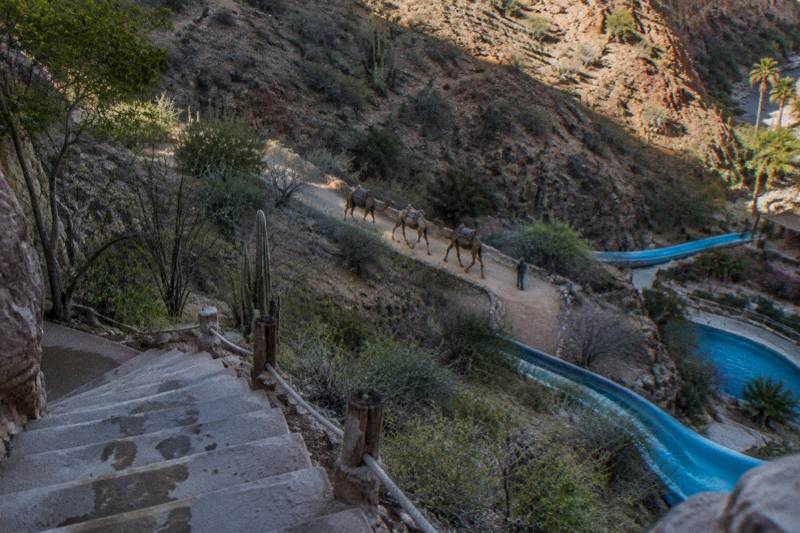
What To Wear On A Camel Ride In Cabo
A camel ride in Cabo is a desert-and-beach outing, not a petting-zoo stroll, and what you wear decides whether the day feels easy or punishing.

Short answer
Wear closed-toe shoes, lightweight long pants, a loose long-sleeve layer, a hat with a brim, sunglasses and reef-safe sunscreen. Plan for dust, midday heat and a separate park or ranch fee of $15 to $25 per person on most rides. Skip skirts, flip-flops and dangling accessories, and leave cameras and phones behind where the operator bans them.
Deciding what to wear on a camel ride in Cabo comes down to three things: dust, sun and the saddle. Every camel listing in this region, from the Cactus Tours beach encounter at Migrino to the Cabo Adventures buffet and tequila ride at the Tierra Sagrada ranch, shares the same desert-and-coast setting, and the same packing logic applies whether you spend 25 minutes in the saddle or a full afternoon at the ranch. Riders who dress for it report comfortable days. Riders who arrive in flip-flops and a swimsuit cover-up report hot sand, gritty toes and sunburn.
The stakes are real but modest. Camels here walk at a slow pace, riders go tethered in single file, and saddle time on shared rides runs roughly 10 to 30 minutes depending on the operator, with Cactus Tours stating about 25 minutes of riding on its beach encounter. The rest of the day is transport, ranch time, a meal and often a tequila tasting. Your outfit needs to survive the whole arc of the day, not just the ride, and this guide walks through clothing, footwear, sun protection and the items you should leave on the bus.
What Should You Wear On A Camel Ride In Cabo?
The short answer is lightweight long pants, closed-toe shoes, a breathable top with sleeves you can add, a wide-brim hat, sunglasses and sunscreen applied before you leave the hotel. Natural fibers or quick-dry synthetics beat heavy denim, which turns stiff with dust and sweat. Dark colors soak up desert sun, so lighter shades keep you measurably cooler across a three to six hour outing.

Long pants matter more than most first-time riders expect. The saddle and the camel's coarse hair create friction, and even at a walking pace bare calves can end up scratched or irritated after 20 to 30 minutes. Loose-fitting pants in linen, cotton or a hiking synthetic solve this completely. Shorts will not ruin the ride, but riders who wear them frequently mention rub marks in guest reports, and on beach rides the sand itself is hot to stand in while you mount and dismount.
For your top, think in layers even in hot weather. Early morning and winter departures can start cool, canyon and coastal breezes cut the heat, and a loose long-sleeve shirt shields your arms from sun better than sunscreen alone over a long afternoon. A hat with a brim that survives wind is worth more than a cap, since Pacific beaches like Migrino are exposed with no shade or facilities at all, a detail the beach guides for the area state plainly.
A quick word on swimwear. Some listings include beach time or a water park element, notably the Wild Canyon camel and water slides combo, so wearing a suit under your clothes is sensible on those days. On a pure beach ride, a swimsuit alone is the least practical thing you can wear: no pocket for anything, no protection from the saddle, and full sun on every square inch of skin.
If you want the deeper rundown of how the whole day unfolds, see what to expect on a Cabo camel ride, which covers the timeline from pickup to tequila tasting.
Which Shoes Work Best For Riding A Camel?
Closed-toe shoes with a flat sole are the right call: sneakers, light hikers or strap sandals with a back. The camel's mounting platform and the desert floor are dusty and uneven, beach sand at Migrino gets hot under midday sun, and flip-flops fail at every one of these. There is no stirrup to trap a shoe, so anything you can walk a mile in comfortably will ride fine.
The biggest footwear mistake is treating the day like a beach day. You will walk from the transport to the ranch or beach staging area, stand around during the safety briefing, climb a raised platform to mount, and possibly hike a short ecological trail, the Cactus Tours encounter includes a desert hike as part of its roughly three hours. Thin soles and open toes make each of those moments worse, and dropped flip-flops on sand are a small comedy nobody wants to star in.
Strap sandals with a heel strap are acceptable in practice and cooler than sneakers in summer. Slip-on canvas shoes work but expect them to fill with fine dust, which is a feature of the whole region rather than any single ranch. Riding-specific footwear is absolutely unnecessary. The animals walk slowly, there is no trotting on the listings described here, and guides handle the animals.
One more consideration for combo riders. The UTV and camel pairings, such as the beach CAN-AM and camel ride from Cactus Tours, add an hour of off-road driving where closed toes are required by any sane operator, and the Cabo camel ride and ATV combo guide covers the gear implications of doubling up. The same sneakers that ride a camel drive a side-by-side, so one pair of shoes covers the whole day.

How Do You Dress For The Beach Versus The Canyon?
Beach rides at Migrino call for maximum sun protection and wind-resistant layers, since the shoreline has no shade, no facilities and strong surf nearby. Canyon rides at Wild Canyon call for similar coverage plus clothes that can take a water park, because that listing pairs the camel ride with water slides and snacks. In both cases the core outfit is the same: pants, closed shoes, hat, sunscreen.
The beach and canyon settings genuinely differ, and it is worth knowing which one your listing uses before you pack. Migrino Beach sits on the Pacific coast off Highway 19 around Km 97, roughly a 20 to 30 minute drive from Cabo San Lucas, with fine sand stretching about 4.3 km, pounding surf and currents that make swimming dangerous, and no shade or facilities, as local beach guides describe. Operators such as Cactus Tours run their beach encounters from a base at Km 100. You are standing in full sun on open sand, and the wind can be brisk in the afternoon.
The canyon is a different microclimate. Wild Canyon Adventures rides camels in the canyon rather than on the beach because, as the operator's page explains, beach salt irritates a camel's sensitive skin, and its guides may pause or end a ride for the animals' wellbeing. The canyon offers some rock walls and partial shade, though the sun still finds you, and the same listing bundles access to water slides, which means you may want quick-dry clothes and a dry layer for after.

Here is how the three ride settings compare for clothing purposes:
| Ride setting | Typical listings | Terrain underfoot | Clothing priority | Extra fee on arrival |
|---|---|---|---|---|
| Pacific beach (Migrino) | Cactus Tours beach encounter from $95 per person, FunCabo marina ride from $114 per person | Soft hot sand, wind, no shade | Sun coverage, wind layer, hat that grips | $25 park fee (Cactus), $25 park fee (FunCabo) |
| Canyon | Wild Canyon camel and water slides from $115 per person | Dirt and rock, partial shade | Quick-dry clothes, shoes for slides, dry layer | $25 park fee |
| Ranch and desert trail | Cabo Adventures buffet ride from $74 per person, Baja Discover safari from $130.21 per person | Packed dirt, corrals, trails | General desert kit, layers for a 5 to 6 hour day | $25 park fee both |
Quick-dry fabric is the quiet hero of the canyon day. The Wild Canyon listing states its camel ride is followed by water slides and snacks within a four hour window, and wet cotton stays wet for hours in Baja humidity, while a synthetic hiking shirt or swim top dries on the walk back to the transport. For a fuller comparison of the two riding environments, beach versus desert camel rides in Cabo breaks down the tradeoffs beyond clothing.
The Wild Canyon canyon and water slides ride is the listing that most changes your packing list, because it is the only one that reliably gets you soaked. Everything else on the lineup stays dry.
What Sun Protection Do You Need In The Cabo Desert?
Plan for sunscreen SPF 30 or higher reapplied at least once, sunglasses, and a hat with a retention strap, plus a lip balm with SPF. Desert and beach rides run two to six hours with most of it outdoors, and the SMN climate station for Cabo San Lucas shows mean monthly highs above 30C from April through October, with 34.4C in July. Reflected sun off sand adds to the dose.
The climate record for the region is unambiguous about how much sun protection this outing demands. The official SMN normals for station 03005 in Cabo San Lucas show that even January, the coolest month, averages a mean high of 26.6C, and the warm half of the year runs from May's 32.1C through August's 34.7C. Rain is almost irrelevant outside late summer: April averages 0.0 mm and May 0.1 mm. Sun, not weather, is the thing you dress against for most of the year.

Sunscreen should go on before pickup, not at the ranch, because several operators, Cactus Tours among them, restrict or ban phones and cameras on shared rides, and you will not want to dig through a bag mid-briefing. Choose something that survives sweat, and reapply at the meal break, which most longer listings include. A lip balm with SPF is the item riders forget and regret: the combination of sun, wind and dust is brutal on lips, especially on the exposed Migrino shoreline.
Sunglasses are close to mandatory on a beach ride. The Pacific shoreline here is wide open, the sand is pale and reflective, and afternoon wind lifts grit. Any style works, but a strap keeps them on your head when you look down at the camel or step off the transport. The same logic applies to hats: a baseball cap is better than nothing, but a wide brim shields your ears and neck, which take the full reflected dose on sand.
One health note riders should weigh: the desert heat is real, and the listings themselves flag medical screening. The Cabo Adventures listing text states its rides are not recommended for travelers with back problems and require no serious medical conditions, so honest self-assessment belongs alongside the packing list. For more on that screening, see the Cabo camel ride weight and age limits guide.

How Does The Season Change What You Wear?
In the November to April window you can wear lighter coverage and should still bring a layer for cool mornings, when mean lows run 12.8C to 17.5C. From May through October, cover more skin, not less, and go looser and lighter, because mean highs sit at 32C and above and the sun is the main hazard. August and September add rain risk to the packing math.
The monthly normals from the SMN station, the official Mexican climate record, show a smaller seasonal swing than most visitors expect in temperature but a sharp one in rain. Here is the year laid out:
| Month | Mean high C | Mean low C | Rain mm | Clothing read |
|---|---|---|---|---|
| January | 26.6 | 12.8 | 6.2 | Warm midday, jacket for early pickup |
| February | 27.0 | 12.9 | 3.4 | Same as January, dry |
| March | 28.5 | 13.9 | 1.4 | Ideal riding weather |
| April | 30.1 | 15.4 | 0.0 | Dry, sun becoming intense |
| May | 32.1 | 16.5 | 0.1 | Full sun kit, lighter colors |
| June | 32.6 | 18.5 | 0.4 | Full sun kit |
| July | 34.4 | 22.5 | 8.1 | Peak heat, loose long sleeves |
| August | 34.7 | 23.8 | 76.4 | Peak heat plus storm chance |
| September | 33.7 | 23.3 | 114.0 | Wettest month, humid |
| October | 33.4 | 21.2 | 24.4 | Hot, storm season winding down |
| November | 30.4 | 17.5 | 16.9 | Warm days, cooler starts |
| December | 27.4 | 14.0 | 7.3 | Comfortable, layer for mornings |
Two seasonal notes belong beside the table. First, Eastern Pacific hurricane season runs May 15 to November 30 with a peak August to October; rides run year-round, and cancellations reported in the region have hit boat tours rather than land-based camel rides, but a light rain shell is a reasonable August and September addition. Second, November to April overlaps whale season, December 15 to April 15, which is why many riders consider it the most comfortable window for a desert outing; the best time to visit Cabo for outdoor tours guide covers that tradeoff in full.
Season also nudges your color and fabric choices. A black tee at 34C is a personal sauna; the same cut in white or tan cuts the felt heat noticeably. In January and February, riders on early departures from the marina or hotel zone regularly wish for a fleece for the outbound drive, then shed it by mid-morning when the sun climbs past 25C.
For families, the seasonal logic applies doubly to children, who run hot on the ranch and cold in the transport air conditioning. The Cabo camel ride with kids guide goes deeper on ages, minimums and keeping small riders comfortable through the full outing.
What Should You Leave On The Bus Or At The Ranch?
Leave phones, cameras, jewelry, scarves and anything dangling in your bag or on the transport, because several operators ban or restrict them on shared rides. Cactus Tours does not allow phones or cameras on shared tours, only hands-free GoPro-style cameras, and the Cabo Adventures listings state cameras are not permitted during the camel ride itself. Operators sell photos, which is the business logic behind the rule.
The camera rule is the packing item that surprises the most riders, so it deserves its own spotlight rather than a footnote. The Cactus Tours page for its camel ride states plainly that phones and cameras are not allowed on shared tours, with hands-free action cameras as the exception, and its private option is where phones come back out. The Cabo Adventures listings carry equivalent wording, stating cameras are not permitted during the ride. The practical upshot: if photos of you on the camel matter, budget for the operator's photo package rather than planning a selfie.
| Item | Bring it? | Why |
|---|---|---|
| Phone | Leave on transport | Banned on shared rides by Cactus Tours and Cabo Adventures |
| Handheld camera | Leave on transport | Same camera restrictions |
| Hands-free action camera | Yes, if you own one | Cactus Tours allows GoPro-style on shared tours |
| Cash for the park fee | Yes | $15 to $25 per person extra on most rides, sometimes cash on arrival |
| Sunscreen and lip balm | Yes | Full-sun outing, high mean temperatures year-round |
| Hat with strap | Yes | Wind on the Pacific beach |
| Jewelry, loose scarves | No | Dust, wind, and snag risk around animals |
| Swimsuit under clothes | Only for slide and beach listings | The Wild Canyon combo gets you wet |
Jewelry and loose accessories earn their ban for a simpler reason: dust and animals. A dangling earring near a curious camel is an avoidable risk, fine chains trap grit, and anything not secured tends to end up lost in sand, which is exactly where nobody will find it. A cheap watch or none at all beats a good one on this day.
That cash line deserves emphasis because it is a clothing-adjacent planning item riders often miss. Nearly every listing here excludes a separate park or ranch entrance fee: $25 per person at Cabo Adventures with half price for kids, at Cactus Tours, at Wild Canyon and at Baja Discover, $20 at the Gray Line ranch and on the One Way Mexico desert combo, and $15 on the One Way Mexico beach ride. Only the Todos Santos ranch tour from Cabo Adventures, from $119 per person, carries no fee note. The full pricing picture, including how those from prices compare across the lineup, is laid out in the Cabo camel ride prices guide.
Does Your Outfit Interact With Age And Weight Limits?
Loose clothing does not change any operator limit, but knowing the limits changes how you plan: the listings state minimum ages of 4 to 5 and rider weight maximums of 100 kg to 125 kg depending on the operator. Wear what is comfortable and realistic, because a heavy jacket or loaded backpack is not the obstacle, the stated per-rider limit is, and no outfit works around it.
The limits are operator-specific and printed on each listing, so a family packing for a mixed group should check their exact ride before departure. Here are the stated figures from the listings compared on this site:
| Listing | Operator | Min age | Rider weight max | Group max |
|---|---|---|---|---|
| Beach Camel Ride and Encounter | Cactus Tours | 5 | 125 kg | 100 |
| Camel Ride in the Canyon and Water Slides | Wild Canyon | 4 | 100 kg | 10 |
| Beach Camel Ride, Buffet and Tequila | Cabo Adventures | 5 | 120 kg | 70 |
| Camel Ride and Sky Bike | Cactus Tours | 5 | 125 kg | 100 |
| Magical Todos Santos Tour | Cabo Adventures | Not stated | Not stated | 14 |
Where a listing states no minimum age or no weight limit, ask the operator before booking rather than assuming; several smaller listings in the lineup, including the FunCabo marina ride and the Baja Discover safari, state neither. Cactus Tours also states that pregnant guests and guests with back or neck problems are not permitted on its rides, an operator policy worth knowing alongside its 125 kg maximum.
Clothing interacts with limits in one practical way: shoes and pants need to work at the mounting platform. Riders step up onto a raised platform to reach the saddle, so a pant leg loose enough to move in and a shoe with grip make the mount, dismount and the short walk to the platform smoother for everyone, including the guides who steady you.
Which Rides Reward Which Outfit Choices Most?
The longer and more varied the listing, the more your outfit has to multitask. A two hour beach ride needs one outfit, while a five or six hour ranch day with a buffet, a tasting and a hike asks for layers, and combo rides with ATVs or sky bikes add dust, helmets and possibly water. Match the outfit to the listing's duration and inclusions rather than to the camel itself.
The sky bike pairing from Cactus Tours is the clearest example of outfit multitasking. It runs four hours, from $125 per person plus the $25 park fee, and combines the beach camel encounter with an hour on a sky bike suspended above the canyon, so the same closed shoes and snug hat that serve the camel serve the bike, and loose scarves or untucked drawstrings become hazards at height. Riders report the pairing as the day where dressing plainly pays off most.
The CAN-AM side-by-side and camel combo goes further in the same direction. At three hours and from $175 per person plus the $25 park fee, it adds helmets and off-road dust to the camel portion, and riders who arrive in white linen leave wearing most of the desert. A bandana or buff for your face is the single best addition to this outfit, and it costs almost nothing.
Not every rider wants engines. The Baja Discover camel safari with lunch and tequila tasting, from $130.21 per person plus the $25 park fee, runs a shorter 2.5 hours but includes hotel pickup and a meal, so the outfit calculus is comfort over a longer door-to-door day rather than protection from dust. Light colors and a real hat carry that day.
For riders who want the outfit question settled by destination rather than activity, the split is simple: beach listings at Migrino mean sun and wind gear, the canyon listing means quick-dry clothes, and the long ranch days mean layers. The how to choose a camel ride in Cabo guide walks the full decision from price to pickup point if clothing is just one box on your list.
Common Questions About What To Wear On A Camel Ride In Cabo
What should you wear on a camel ride in Cabo?
Lightweight long pants, closed-toe shoes, a breathable top with sleeves, a brimmed hat, sunglasses and sunscreen. Add a layer for cool mornings from November to April, and go looser and lighter from May to October when mean highs sit at 32C and above.
Can you wear shorts and flip-flops on a camel ride?
Physically, usually yes, but it is the worst version of the day. Bare legs can rub against the saddle and the camel's coarse hair over 10 to 30 minutes of riding, hot sand at the beach hurts bare feet, and flip-flops make mounting the platform awkward. Sneakers or strap sandals with a back are the comfortable choice.
Do you need a swimsuit for a Cabo camel ride?
Only on listings that include water. The Wild Canyon camel and water slides combo is the one that reliably gets you wet, so a quick-dry suit under your clothes works there. Beach rides do not include swimming: Migrino has strong surf and currents and swimming is not recommended.
Can you bring a phone or camera on the ride?
Often no. Cactus Tours states phones and cameras are not allowed on shared tours, with hands-free action cameras as the exception, and the Cabo Adventures listings state cameras are not permitted during the camel ride. Plan on the operator's photo package if you want pictures of the ride itself.
Is it too hot to ride a camel in summer in Cabo?
Rides run year-round, but July and August average mean highs of 34.4C and 34.7C, so full sun coverage matters more than exposure. Loose long sleeves, lighter colors, a real hat and early departures are the summer strategy, and November to April is the window riders find most comfortable.
What should kids wear on a camel ride?
The same kit as adults, sized down: closed shoes for hot sand and platforms, a hat that stays on, and a layer for the air-conditioned transport. Minimum ages on the listings run from 4 at Wild Canyon to 5 at Cactus Tours and Cabo Adventures, and kids' park fees are half price on Cabo Adventures rides.
Dressing well for one of these outings is genuinely simple once you know the setting, and Cabo Camel Tours keeps the full lineup of beach, canyon and combo listings in one place so you can check the terrain, the fee and the inclusions before you pack. Closed shoes, long pants, a hat, sunscreen and nothing dangling covers essentially every ride described here, from the 25 minute saddle time of a beach encounter to a six hour Todos Santos ranch day. The camels walk slowly. The sun does not.